WORLD & GAMEFEATURES

RedCell isn't one map with modes bolted on — it's a collection of self-contained worlds, each shipped as a GameFeature plugin and wired up at runtime by an Experience definition. The core game stays lean; every world brings its own content, systems, and rules with it.
01 | GameFeatures
Worlds as Plugins
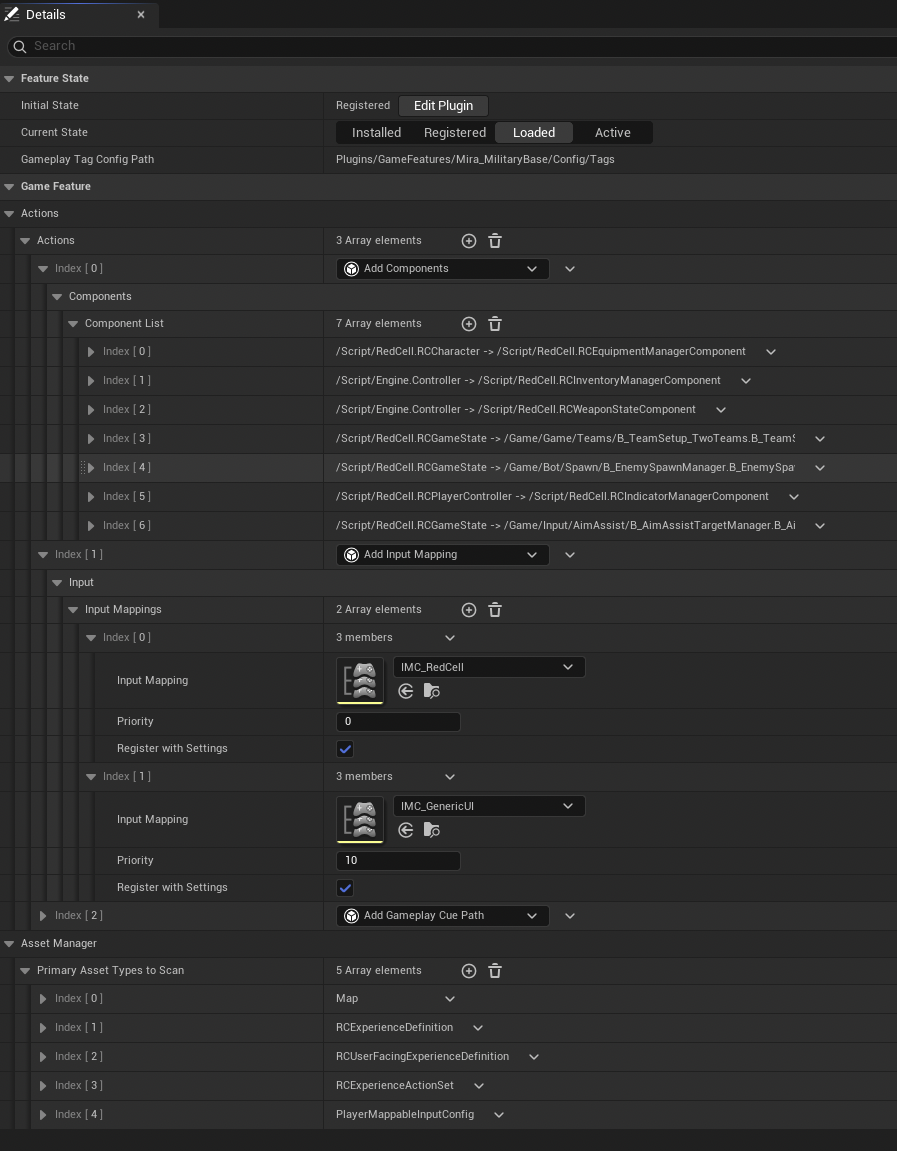
Each world — Military Camp, Mira HQ, Apartment Base — is a GameFeature plugin carrying its own maps, assets, gameplay tags, and feature actions. Worlds activate and deactivate as units, which keeps content isolated, the footprint small, and makes adding a new world a simple additive operation.
02 | Experiences
Experience-Driven Runtime
The Experience Definition is the contract for each world: it adds the necessary GameState components — Enemy Spawn Manager, Music Manager — declares the pawn data, and applies action sets that grant abilities and register input mappings.
This assembly is what makes the rest of the project composable. For instance, Apartment Base is a transition map where the player regroups between missions, so its Experience declares a lighter component loadout with no weapon abilities.
03 | World Travel
Seamless Travel Between Worlds
Players move between worlds through in-game travel actors and seamless travel, so the session always continues. States that should persist — such as the player's inventory — is captured before the world tears down and restored after possession in the new one, while everything world-specific shuts down cleanly.
04 | Construction
Modular Level Building
Levels are assembled from modular kits: rooms and corridors are grouped as small module maps, baked into PackedLevelActors for cheaper instancing, and composed into worlds through Level Instances. Iterating on a module updates every placement of it within the world.
Gameplay layers such as Traversal ledges (vault, mantle, hurdle volumes) live in lightweight overlay actors one layer above the packed content, so art and gameplay iterate independently.